Ways of Thinking in a Critical Scenario Simulation
A Qualitative Study of Rumination in a Police Student Sample
Assistant Professor, PhD Student
Norwegian Police University College, Norway
University of Bergen, Norway
kristin.stenshol@phs.noProfessor
University of Bergen, Norway
Professor
University of Exeter, United Kingdom
Associate Professor
Norwegian Police University College, Norway
Publisert 20.08.2025, Nordic Journal of Studies in Policing 2025/1, Årgang 12, side 1-23
Critical incident policing challenges the cognitive capacities of police officers. This study examines third-year police students’ reported thinking processes during a critical incident simulation, focusing on rumination, characterised by persistent and repetitive dwelling on thoughts, experiences, or personal states. Thematic analysis of interviews with ten participants concluded on three main themes: “Preparatory thoughts”, “tuning into the situation” and “the aftermath”, each encompassing multiple subthemes. Our analysis suggests that differentiating between rumination’s constructive and unconstructive aspects aids in understanding police students’ thinking processes in this context. For the most part, participants reported engaging in constructive facets of deliberate and concrete rumination before and during the exercise. Post-exercise, their thinking became more evaluative and reflective, often focusing on negatively valenced content. Such thinking could potentially lead to both constructive reflection and unconstructive brooding rumination. We propose that police training could benefit from encouraging deliberate and concrete rumination during and reflective rumination after exercises to enhance cognitive preparedness for critical incidents in later duty.
Keywords
- police education ;
- critical incidents ;
- cognitive processes ;
- rumination ;
- thematic analysis
1. Introduction
Police work encompasses a range of tasks, from providing practical assistance to citizens in need to addressing critical incidents where lives are at stake. Police-citizen encounters carry the inherent risk of turning violent and life-threatening (Kalkhoff et al., 2022; Preddy et al., 2019), underscoring the importance of police readiness. At the critical end of the continuum, police officers operate as first responders, with a mandate to save lives and protect the public and property (Akinci & Sadler-Smith, 2020). Although critical encounters are rare (Huhta et al., 2021), they require immediate and prompt resolution when they do occur.
Due to the inherent risk of critical incidents, policing is considered a stressful and emotionally taxing occupation (Dilawar et al., 2019; Eddy et al., 2019; Padyab et al., 2023; Sutton & Polaschek, 2022; Van Hasselt et al., 2008; Verhage et al., 2018). Regardless of the circumstances, police officers are expected to make the right decisions resulting in the execution of appropriate, life-saving behaviours. It is imperative that they maintain mental clarity to be able to perceive and act upon critical information as it unfolds in an ever-changing situation. Undoubtedly, police work during critical incidents challenges police officers’ cognitive resource capacities. Accordingly, this study aims to explore the thinking processes of police students during a critical incident scenario, with particular focus on rumination – a way of thinking that may contribute to the depletion of cognitive resources.
1.1 Influencing factors in policing: The role of cognition
Police science literature has identified various factors influencing police decision-making and performance, including personality, emotions, stress and cognitions. Low neuroticism and sensation seeking (Girodo, 2007) and high extraversion (Huhta et al., 2021) have been linked to decision errors and unnecessary risk taking, potentially leading to negative outcomes in critical police encounters. Anxiety has been associated with reduced shooting accuracy under pressure (Nieuwenhuys & Oudejans, 2011), while anger has been shown to heighten threat perception, increasing the probability of misidentifying neutral objects as threats (Baumann & DeSteno, 2010). Stress is shown to cause perceptual deficiencies such as attention narrowing and auditory exclusion, where central vision dominates over peripheral vision and temporary hearing loss increases reliance on visual information (Klinger & Brunson, 2009; Verhage et al., 2018). Stress-induced reduction in shooting skills, non-verbal communication and self-defence abilities have also been documented (Anderson et al., 2019).
Relatively less research has explored the effects of cognitive processes – referring to mental processes concerning, e.g., perception, consciousness, intelligence and thinking (Kellogg, 2015) – in critical police encounters (Preddy et al., 2019). A key area of interest is processing styles, often framed within dual-process models, contrasting analytical, effortful with intuitive, effortless processes (Brown & Daus, 2015; Hunt et al., 1989; Kahneman, 2011). Given the time constraint of operative environments, intuitive processing is generally assumed to dominate (Roberts & Cole, 2018). However, the suitability of both decision styles is still being debated (see Kahneman & Klein, 2009).
Girodo (2007) examined processing styles in policing alongside personality in police special squads. He found that errors occurred when situations demanded higher-order cognitive processes, but procedural knowledge was used, and vice versa. Whereas procedural knowledge is comparable to intuitive processing characterised by less consciousness and reactive and sequential actions, higher-order processes are comparable to analytical processing, which is more rule-based, analytic and explicit. Moreover, Power and Alison (2017) studied emergency responders, including police, and found that challenges related to incident characteristics or team dynamics led emergency commanders to redundantly deliberate on potential negative consequences in emergency episodes, resulting in decision inertia. For a broader review of factors influencing police behaviour, see Cojean et al. (2020).
The above studies on cognitive processes in policing suggest a link to the concept of rumination, a form of persistent and repetitive thinking that can disrupt information processing (De Lissnyder et al., 2012; Watkins & Roberts, 2020). Rumination can be categorised into abstract – evaluative processing akin to higher-order cognitive processes – and concrete experiential processing, aligning more with the use of procedural knowledge (Di Schiena et al., 2013). Across definitions, rumination shares key features with redundant deliberations such as the repetitiveness or reoccurrence of thoughts, often involuntary and intrusively (see, e.g., Brinker & Dozois, 2009; Martin & Tesser, 1996; Nolen‐Hoeksema, 2003; Watkins & Roberts, 2020).
Research on rumination in a police setting is limited and have mainly been confined to examinations of its effects following traumatic events. Studies have found associations between intrusive rumination and secondary traumatic stress, PTSD and burnout (Juczyński & Ogińska-Bulik, 2022; Ogińska-Bulik et al., 2023) as well as links between deliberate rumination and secondary post-traumatic growth (Ogińska-Bulik & Bąk, 2025). The following paragraph will further describe these two forms of rumination.
1.2 Rumination
Rumination is a distinct way of thinking that overlaps with but also differs from related cognitive phenomena. It is often classified as perseverative cognition, defined as “the repeated or chronic activation of the cognitive representation of one or more psychological stressors” (Brosschot et al., 2006, p. 6), encompassing rumination, worry and angry brooding (Brosschot et al., 2006). Also, rumination is included within the broader concept of repetitive thought, a transdiagnostic process that includes rumination, worry, perseverative cognition, mental simulation and reflection, alongside other concepts (Watkins, 2008). Repetitive thought is described as “the process of thinking attentively, repetitively, or frequently about oneself and one’s world” (Segerstrom et al., 2003, p. 909). These broader conceptualisations differ in how they position related concepts across hierarchical levels. However, both highlight defining features of rumination such as persistent, repetitive thoughts, as well as its thematic focus, whether on psychological stressors or the self and one’s world. Categorising rumination within these conceptualisations, allows clearer differentiation between concepts. A common distinction is between worry and rumination, where worry is typically future-oriented and associated with anxiety and rumination is predominantly past-oriented and linked to depressive affect (Ottaviani et al., 2016; Querstret & Cropley, 2013).
Most research on rumination has been focused on clinical populations. For example, studies indicated that rumination contributed to cognitive impairment and indecisiveness in individuals with depression or dysphoria (Lyubomirsky et al., 2003; van Randenborgh et al., 2010). Similar trends have appeared in non-clinical samples. Beckwé et al. (2014) found that rumination was associated with reduced cognitive control – the ability to inhibit interferences, concentrate on important information, and update working memory – among undergraduates. Likewise, Koster et al. (2013) linked rumination to difficulties in attention switching especially for negative content, also for undergraduates. Brinker et al. (2013), examined rumination’s relationship with mood and cognitive impairment, finding rumination to be associated with cognitive impairment regardless of mood under both low and high cognitive load situations. Cognitive load refers to the mental effort required for a task, limiting resources for other processes (Barrouillet et al., 2007). Under low cognitive load, available resources allowed intrusive thoughts to disrupt task performance, whereas high cognitive load, induced by demanding tasks, left the mind overwhelmed, making it more susceptible to ruminative thoughts (Brinker et al., 2013).
Operative policing heavily depends on cognitive control, decision-making abilities, and accurate and rapid performance. A failure to process new relevant information in critical encounters could have severe consequences. High cognitive load, common in critical police encounters, may increase susceptibility to rumination. Moreover, stressful situations with larger potential consequences are known to elicit rumination (Rosenbaum et al., 2021), making its occurrence likely in police populations due to stressful circumstances (Baldwin et al., 2021; Sandvik et al., 2020).
1.2.1 Different conceptualisations and facets of rumination
The literature on rumination is extensive and spans multiple domains, with no unified definition (Siegle et al., 2004; Smith & Alloy, 2009). Instead, definitions vary, with some conceptualising rumination as a unidimensional construct while others adopt a multidimensional perspective (Joormann et al., 2006). Some definitions restrict rumination to specific content domains, such as depression (see Nolen-Hoeksema, 1991), whereas others view it as a general thinking process independent of content. For example, Martin and Tesser’s (1996) control theory conceptualises rumination as a class of thinking triggered by unresolved goals, rather than a coping mechanism tied to a particular domain. They propose rumination persists until goals are achieved or disengaged and describe it as “a class of conscious thoughts to revolve around a common instrumental theme and that recur in the absence of immediate environmental demands requiring the thoughts” (p. 7). Although conceptualising rumination as unidimensional, the authors recognised different modes, suggesting rumination could be both positive or negative, oriented towards past, present or future events, and related to both completed and uncompleted tasks. Brinker and Dozois (2009) further characterised ruminative thoughts as repetitive, recurrent, uncontrollable, and intrusive.
More recent research has explored rumination as a multifaceted construct, delineating a dichotomy between positive, constructive and negative, unconstructive rumination. García et al. (2017) identified four distinct types through confirmatory factor analysis: brooding, reflection, deliberate and intrusive rumination, supporting their distinction in separate constructs. Brooding involves passive comparisons between one’s situation and unachieved goals, whereas reflection entails cognitive problem-solving that alleviate negative emotions (Treynor et al., 2003). Deliberate and intrusive rumination are primarily studied in individuals who have endured trauma. Deliberate rumination, characterised by voluntarily revisiting thoughts to process a difficult event, is linked to post-traumatic growth, whereas intrusive rumination involving uncontrollable, distressing thoughts, is associated with psychological distress (Cann et al., 2011; Huh et al., 2020; Kim & Bae, 2019; Taku et al., 2009; Xu et al., 2019). Other contributions distinguish concrete from abstract rumination. Concrete rumination is process-focused and specifically centred on “how” to solve a situation, prompting thoughts about actionable steps, problem-solving and means to an end. In contrast, abstract rumination is evaluative and overly general, focusing on “why” questions, leading to reflections on causes and consequences, potentially impeding progress (Altan-Atalay et al., 2022; Watkins et al., 2008; Watkins & Roberts, 2020). Experimental studies confirm that concrete rumination enhances problem-solving and accelerates emotional recovery compared to abstract rumination (Watkins & Baracaia, 2002; Watkins & Moulds, 2005).
To our knowledge, little research has investigated rumination during critical police encounters, leaving a significant gap in understanding its real-time impact on police behaviour.
1.3 Current study: Rumination in a police setting
Based on our examination of existing literature, we wanted to investigate the thinking processes involved in critical police encounters – exemplified by a simulated exercise with police students – and consider whether rumination could serve as a viable conceptual framework for understanding these processes. Critical police encounters – being both stressful and representing high cognitive load – could lead to ruminative thoughts. Further, ruminative thoughts have been shown to be associated with a variety of cognitive deficiencies. Hence, we wanted to investigate the potential presence of ruminative thinking to better understand and address the ramifications of such cognitions in a police setting. To this end, we performed a study addressing the following research question: What characterises police students’ thinking processes during a critical scenario simulation, and how do these thinking processes correspond to different forms of rumination? We approached this investigation with the underlying assumption that rumination could manifest in different ways with both positive and negative consequences. Due to limited precedent, we chose a methodological approach that started out with an open stance towards rumination’s role in police operations, instead of committing to a priori theoretical stance.
2. Method
2.1 Setting, study design and participants
This study is part of a research project investigating police students’ thinking and decision-making during critical incidents, using surveys, observation and interviews. This paper qualitatively analyses thinking processes based solely on the interview data. The sample comprises third-year police students from Norwegian Police University College where training spans three years: Basic policing skills on campus in year one, a supervised internship with operational duties in year two, and theory and training, including scenario-based use-of-force training, on campus in year three. Given their training and field experience, their thinking processes may resemble those of active police officers.
All 404 third-year police students at the Norwegian Police University College were invited via email to participate in the study. Eighty-six students were sampled through self-selection on the principle of “first come, first served” until available slots in the simulator were filled. The study material consists of debriefing and in-depth interviews with a subsample of ten participants following their participation in a critical scenario simulation, in total 20 interviews. Purposeful sampling was used for the subsample to accommodate the interviewer’s available time slots. Given the limited research on rumination in operative policing, a qualitative approach was chosen for deeper exploration.
2.2 Data collection
We wanted to simulate a critical incident represented by a high-threat scenario that could potentially elicit ruminative thinking. The data collection was performed by the first author, assisted by a police instructor. Before the simulated exercise, participants received a briefing (Appendix 1) with minimal information. Guided by the instructor, participants individually, without other observers, engaged in a critical encounter using a MILO (multiple interactive learning objectives) Range 4 simulator, which provided interactive audio-visual stimuli from a naturalistic setting. They were equipped with training oleoresin capsicum (OC) spray, a baton, and a laser-enabled training pistol (HKP30L), though only firearms triggered system responses. In the on-screen simulation, the participants encountered an armed perpetrator whose agitation escalated progressively throughout the scenario, culminating in shots fired toward the participant had they not incapacitated the perpetrator beforehand. Due to system setup, participants were forced to escalate to firearms as less intrusive means, such as communication or OC, would not stop the perpetrator. The prospect of making life-or-death decisions in the simulated scenario was expected to be stressful and to impose a high cognitive load.
Debriefing interviews were conducted immediately after the exercise. To avoid biased questioning, the first author, who served as the interviewer, was not present during the exercise. These interviews (Appendix 2) included eight open-ended questions about participants’ experienced perceptions, thoughts, judgments, and actions in the exercise. On average, each interview lasted approximately 10 minutes, with the interviewer strictly adhering to open questioning and probing questions with “anything else” until participants had nothing more to add. Successively, participants were taken to a separate location for the in-depth interviews, avoiding any conversation about the exercise to prevent contamination. These interviews (Appendix 3) were more theory-driven, focused and detailed. We posed questions grounded in different theories of rumination instead of choosing one theoretical stance a priori. This was done to ensure that we could later make some qualified assumptions on the suitability of different conceptualisations for this specific setting. For this study, the section in the interview guide exploring thought content and processes were of particular relevance. In the in-depth interviews, the interviewer interacted more extensively with participants, employing follow-up questions to elicit further elaborations. In-depth interviews lasted between 45 and 60 minutes. The participants received no feedback on their performance until both interviews were completed. Some topics covered in the two interviews are not the scope for the current study. For further insights into the entire research project, see our previous publication (Stenshol et al., 2023).
2.3 Data analysis
The first author transcribed the interviews, producing an extensive dataset of 61,430 words – 53,345 from in-depth interviews and 8,085 from the ten debrief interviews. The transcripts were subjected to a thematic analysis defined by Braun and Clarke (2006, p. 79) as “a method for identifying, analysing and reporting patterns (themes) within data.” Selective coding identified all instances of thinking processes, excluding mere perception or action reports while retaining thoughts about perceived information and actions. The analysis combined experiential and theoretical thematic analysis, capturing participant’s experienced thinking processes while aligning them with existing theories on rumination. This approach integrated both inductive analysis, grounded in participant’s experiences, and deductive analysis, interpreting these experiences through theoretical frameworks. The interview guides allowed for both approaches by combining open and theory-driven questions. Results were presented inductively, adhering closely to the participants’ experiences, with translated quotes minimally adjusted for readability. The deductive process, supported by theoretically anchored questions from the in-depth interviews, informed the discussion by linking participants’ experiences to existing theories on rumination.
2.4 Credibility, transferability and dependability
Credibility concerns the trustworthiness of findings and whether data interpretations are logical (Enworo, 2023), while transferability refers to applicability of findings beyond the study context (Malterud, 2001). Ensuring transferability requires both critical appraisals by research users and detailed descriptions of participants and settings from researchers (Drisko, 2025). Lastly, dependability relates to whether results could be consistent with all conditions being equal, making transparency of the research process essential (Enworo, 2023).
In this study, credibility is strengthened by the researchers’ familiarity with the field and participants, being academic instructors at the participants institution, and accustomed to their reasoning in high-stakes exercises. To support transferability, we provide descriptions of both sample and setting, allowing readers to assess its applicability. Notably, Di Nota et al. (2023) found police simulator training to evoke stress physiology comparable to live scenarios, albeit to a slightly lesser extent, suggesting some degree of transferability to real-world policing. Qualitative analysis inherently involves interpretations, which may vary between researchers (Stige et al., 2009). We acknowledge that our perspectives shaped our analysis, and alternative interpretations are possible. However, by providing rich data descriptions and maintaining transparency in our stepwise analytical process, we aim to ensure dependability, meaning the research process is logical, traceable and well-documented (Nowell et al., 2017).
3. Results
Thematic analysis (see figure 1) identified three main themes each comprising three to five subthemes (see figure 2). “Preparatory thoughts” were reported to manifest before or at the start of the exercise, “tuning into the situation” typically occurred during the exercise, and “the aftermath” thoughts followed afterwards. However, these thoughts were not strictly time-bound, as some thoughts appeared at different stages or coexisted. For instance, “mental simulation” – categorised under “preparatory thoughts”, was found to occur both before and during the exercise. Quotes are labelled with the participant number (1–10) and “D” for debriefing interviews or “I” for in-depth interviews.
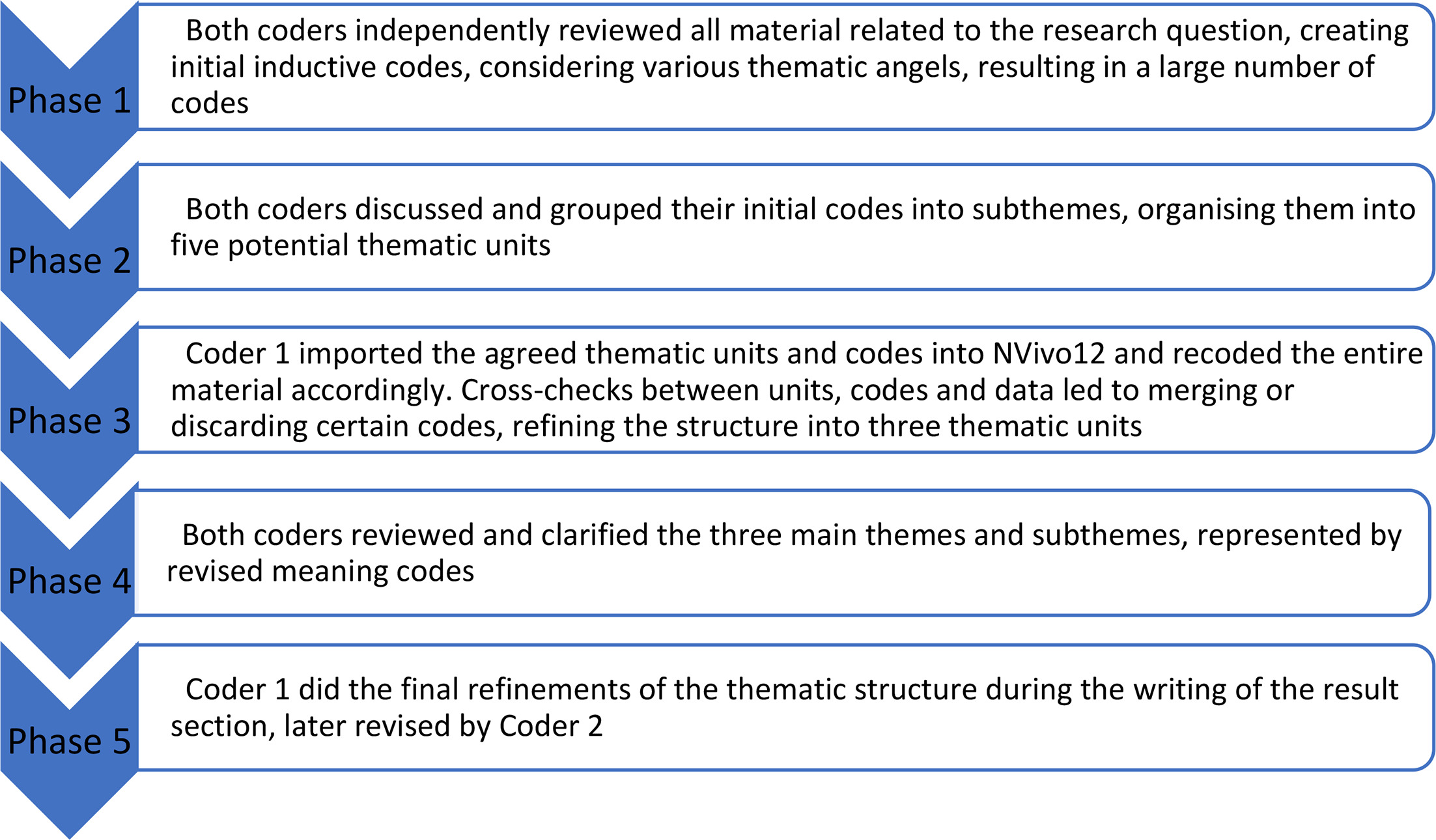
Figure 1.
Overview of the Analysis Process (Coder 1: first author, Coder 2: fourth author)
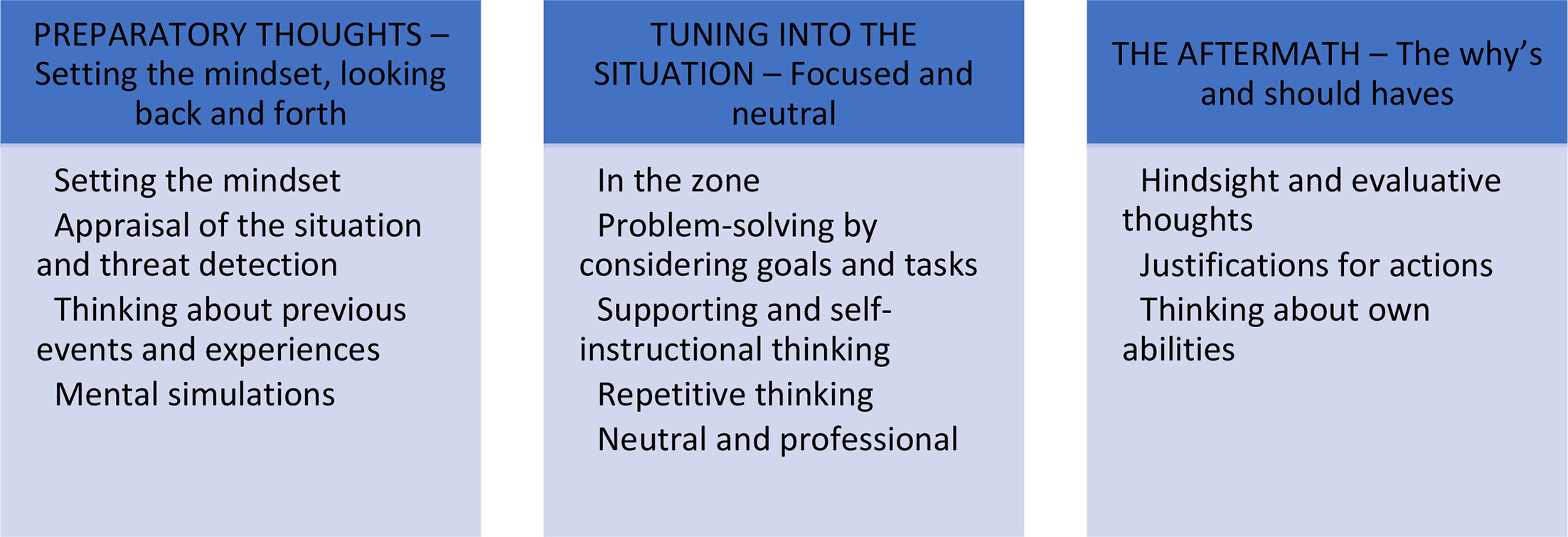
Figure 2.
Overview of Main Themes and Subthemes
3.1 Theme 1: Preparatory thoughts
The first main theme includes four subthemes: “Setting the mindset”, “Appraisal of the situation and threat detection”, “Thinking about previous events and experiences” and “Mental simulations”. These thought processes typically occurred before going into the exercise, in its early stages before taking action, or during the exercise when the participants were uncertain about their next steps.
In preparing for action, many participants typically seemed to deliberately seek a certain mindset they judged valuable in solving the mission, focusing on staying calm, open and attentive.
P5-I: I am trying to be attentive and tuned in, at least in my head. You could meet a lot of different scenarios (…) I did reset myself [to zero] as best as I could (…)
P6-I: Really, it was about trying to think that one should keep calm and trying to see [perceive], and not get locked into a tunnel vision …. So, yes, for the most part, one tries to keep an open mind.
Other preparatory thoughts involved analysing the situation to assess the level of threat, referring to the subtheme appraisal of the situation and threat detection.
P3-D: I perceived him as a threat, sitting on a bench with a pistol, or at least it looked like a pistol. I couldn’t allow him, first, I couldn’t allow him to pick it up.
P1-I: (…) I thought about and observed what was in front of me. There was a man alone on a bench and then I thought that it would be enough to keep my distance, he was calm, try to establish communication with him. Yes, but when I see that pistol, then I think that I must be ready to defend myself. I must get control over the situation.
The appraisals were closely linked to the participants’ perceived necessary actions to neutralise the threat. Their assessments included factors such as weapon presence, the perpetrator’s apparent state of mind, as well as the circumstances of being alone without backup. Threat detection was recalled as a central theme, with some evaluating it as high and others initially low, depending on whether they had noticed the pistol.
Moreover, the participants’ thinking when in a preparatory mode was reported to include both thinking about the past as well as the future. All participants thought about previous events and experiences they judged relevant to the current situation.
P10-I: I did mention [earlier] something about other means of force that could be used, but as I stood there with my pistol and he held his pistol, a thought crossed my mind from what was said in the last training session where the instructor emphasised not holding the pistol and OC simultaneously.
Additionally, the participants tried to foresee potential scenarios that could happen by using mental simulations.
P3-I: … The first thing I pictured could happen, was him throwing himself over the table, going for it [the pistol] …. The second was that he would follow my instructions to stand up and move away from the table …. I also wondered if someone else could suddenly turn up in the picture or the background.
The reported simulations involved at least two potential scenarios, suggesting that participants remained somewhat open-minded and receptive to alternatives.
3.2 Theme 2: Tuning into the situation
The second main theme includes thinking processes that are typically experienced during active engagement with the perpetrator, divided into five subthemes: “In the zone”, “Problem-solving by considering goals and tasks”, “Supporting and self-instructional thinking”, “Repetitive thinking”, and lastly “Neutral and professional”.
Participants described shifting in and out of a mental state resembling being in a zone or a “bubble” as reflected in the following quotes:
P8-D: Just at the moment where the pistol is raised, you could say I “went into a bubble”.
P8-I: I lost my concept of time (…). I don’t know if it took three seconds or twenty. It is impossible to say, as you get so focused on him, on what he is doing and what I want him to do, in a way hoping that he would listen to me.
This mental state is described as being focused on the “here and now”, with some anticipation of immediate, near future events. Unlike the preparatory phase, which involved reflecting on past experiences and envisioning future scenarios, this state is predominantly present oriented.
P2-I: I understand immediately when I start talking (…) or immediately when the scenario starts, that I only remember fragments of the message [the briefing], I forget the message. I must deal with this person, so the only fragment I bring with me is that he appeared to be unstable, that’s it, and then there is the weapon. I forget which company he has visited, that he wanted to talk to his boss, all that disappears for me. (…). So, I will say I am “here and now”.
The participants’ reported focused thinking could have represented both benefits and drawbacks. On the positive side, the participants described a heightened state of attentiveness towards critical information within the scenario. However, it may have led to overlooking important aspects of the broader situation.
P1-I: I experience being very focused on what happens with the man; therefore, I feel that I have little capacity if something else would have happened close by.
Engaging in this exercise involved different thinking processes with various degrees of overlap. From the participants’ reports we find that a considerable amount of thought was devoted to contemplating mission objectives and the actions required to achieve them. This subtheme could overlap with the previous subtheme in the sense that these problem-solving activities could be happening within the before-described zone.
P8-D: There and then, there is not so much more that exists than what you are about to do, and what you should avoid doing.
Participants reported that their contemplation of which actions to take was guided by a preferred final state expressed as mission objectives, primarily separating the perpetrator from the pistol. They also aimed to use minimal force.
P7-D: I planned that nobody should get hurt, that was my main task, to solve the mission on the lowest possible level [of use-of-force].
We were interested in both positive and negative outcomes of the thinking present in the scenario. Therefore, we asked the participants if they experienced their thoughts as help or hindrance. Generally, the thoughts were perceived as helpful and supporting.
P3-I: They [the thoughts] helped me to – in my opinion – to make the right decision.
P7-I: They represented support, a pillar to relate to.
Most of the participants explicitly denied that their thoughts were perceived as a hindrance to their performance supporting the impression that they considered them as helpful.
P2-I: I do not experience any self-sabotage, in terms of what I am thinking. There are no thoughts in the direction that “you cannot do this”.
In many cases, these thoughts were presented as helpful self-instructions, where participants were mentally telling themselves what to do. These instructional thoughts could have been beneficial when the participants were striving to progress in the exercise.
P4-I: But they [self-instructional thoughts] normally come to me if I start feeling that now I am too … at a point where I thought that now you are only talking without getting any effect. “I will have to start to listen to what he is saying”.
We asked the participants if they experienced repetition of the same thoughts (repetitive thinking) as opposed to new thoughts during the exercise. All of them reported the presence of repetition in their way of thinking, of which some stated there to be more of a combination of recurring and new thoughts.
P9-I: No new thoughts, there were a couple of alternatives that one alternated between based on his reactions and actions …. So, it was really the alternation between two alternatives [to shoot or not shoot].
P2-I: I think both, new thoughts are occurring, and several thoughts repeat themselves, that have already been through the system, that you resume because the situation is changing, or he is changing.
The participants reported repetitive thoughts that were closely linked to the current task. Such thoughts revolved around actions they would have to undertake, situational changes and mission goals. They also repeatedly considered the consequences of different actions and potential outcomes.
P3-I: … repeated some thoughts about the consequence, I do circle back to that thought many times, or what I potentially will have to do … What will the outcome be, that is what is returning to me.
Most participants engaged in some sort of consequence thinking. Referring to the above quote, some explicitly described these thoughts as repetitive, while others referred to such thoughts as being of high priority, and therefore most likely to be repeated several times. They often referred to their thinking as “thinking in circles” or “being in a loop”:
P3-I: Constantly reassessing the situation … reassessing what I see all the time …. It is a circle, “What do I see, what does he do, what should I do about it”. So, I feel that it is going in a circle.
We asked participants about the valence of their thoughts when engaging in the exercise. For the most part they considered their thinking to be neutral.
P2-I: Let me think [pause]. I am tempted to say neutral. That could be because you are in a professional mindset where you try to exclude the feeling of positive/negative and only try to work with what you have at the moment.
This participant excluded feelings that were positive or negative to maintain professionalism, aligning with the intentions of staying open-minded from the first main theme. This neutrality may also result from task-focused thinking.
P4-I: [the thoughts were] neutral and were really only focused on the assignment. Concerning the question about how I was thinking immediately after, being unsure whether you were capable of solving the assignment or not. Such thoughts are not present in the moment, at that point, I only have to solve the mission.
Solving the mission leaves little room for emotions or reflections, which seemed to be postponed until after the exercise. When asked if evaluative and reflective thoughts appeared during the exercise, one participant responded:
P4-I: Seldom, it has happened, but I try to push away such thoughts as they do affect the way I am performing.
All in all, the participants appear to have sought a neutral and professional stance during the exercise.
3.3 Theme 3: In the aftermath
The third and final main theme concerns retrospective thinking processes and encompasses three subthemes: “Hindsight and evaluative thoughts”, “justifications for actions” and “thinking about own abilities”. Participants typically experienced these reflections immediately after the exercise, though they occasionally surfaced briefly during the activity. Post-exercise thinking appeared more in-depth and reflective than thoughts during the exercise, suggesting that participants lacked the time to fully engage with such thinking while interacting with the perpetrator. If such thoughts did arise during the exercise, they most likely emerged in fragments and later transformed into longer reflections in the interviews.
P8-D: All that, it kind of progresses automatically by itself, the things I explain in a long way [in the interview], actually happened pretty quickly. I do not necessarily think about it too much [there and then], it sort of just happens.
In hindsight, the neutrality diminishes as participants actively evaluate both the positive and negative aspects of their performance.
P2-I: I am content with having been so clear about what I wanted from him, what the consequences would be and who I was …. [Although] I have this thought that I wish that I had communicated with him to a larger extent.
In the interviews, significantly more time was devoted to contemplating how they could have performed better, as opposed to reflecting on the positive aspects of their achievements.
P7-I: In retrospect, I think that there are other things I should have done differently, such as using a warning shot, or having the weapon [unholstered] earlier and so on. So, at that point [when looking back], there was not much positivity anymore.
P1-I: In a way negative, I am maybe a bit critical by nature, so I am critical towards how this went down. Whether I hit him the way I was supposed to, and whether this was the right way of solving this.
Several participants justified their actions in response to dissatisfaction with some of their conduct.
P2-I: (…) and then one realises, “My God, it’s because I can’t get any response to my communication and because the case is the way it is, one finds the need to justify oneself”. So, both critique and justification on my part.
Especially when using intrusive means of force, the participants felt compelled to justify their actions.
P8-I: (…) When he is standing there with the pistol, I have no chance with any other means than my pistol.
In hindsight, some participants reflected on their abilities. While some reflections were affirmative, such as one participant expressing satisfaction at not experiencing a “freeze” during the exercise, most focused on areas of improvement.
P6-I: I have this tendency to maybe want to think it through too many times before I act. (…) Then I simply get too passive.
Although reflections about their abilities often appeared in hindsight, at times, these reflections surfaced during the exercise, in a way that aligned their abilities with the current situation.
P3-I: and then I think to myself, do I have enough, I am confident enough to keep it [the service weapon] in ready high, and if he does move, then I have the time and the capacity to take the necessary steps.
4. Discussion
The current study aimed to explore the thinking processes of police students as they engaged in a critical scenario simulation and to examine their relationship with the concept of rumination. Given the varied conceptualisations of rumination, our approach focused on identifying resemblances and tendencies rather than determining its definite presence or absence.
When comparing our findings with different conceptualisations of rumination, we observe both similarities and differences. Martin and Tesser (1996) conceptualised rumination as a unidimensional construct, encompassing recurring thoughts centred on a common instrumental theme unrelated to environmental demands, and triggered by unresolved goals. Expanding on this unidimensional notion of the concept of rumination, Brinker and Dozois (2009) characterised ruminative thinking as repetitive, recurrent, uncontrollable and intrusive. In the present study, most of the reported thoughts do not appear to be unrelated to environmental demands, as they are closely linked to immediate problem-solving requirements within the scenario. However, there are indications that these thought processes may be driven by unresolved goals, as participants explicitly articulate their goals for the mission, and they later evaluate their actions against these goals. This often results in dissatisfaction when discrepancies between actions and goals are identified.
Furthermore, participants report their thoughts as repetitive and recurring, though less so as uncontrollable and intrusive. Post-exercise, some tendencies suggest the presence of negative evaluative thinking. Overall, the results indicate thinking processes that can be both constructive and, at times, unconstructive. This aligns most closely with models that conceptualise rumination as a multifaceted construct where this dichotomy is clearly stated (E.g., Altan-Atalay et al., 2022; Cann et al., 2011; Treynor et al., 2003). The following discussion examines how the reported thinking processes relate to different forms of rumination within multifaceted models, encompassing both constructive and unconstructive tendencies. Furthermore, we address some learning points for police education.
4.1 Being constructive and concrete
The thinking processes that our participants experienced before and during the exercise mainly resemble the constructive parts of rumination described in multifaceted models.
The participants appear to have intentionally adopted a specific mindset during their preparation, as well as deliberately recalling past events and future scenarios relevant to the mission. During the exercise, they generally found their thinking to be helpful and guiding, with some employing self-instructions. There are few indications of overwhelming or intrusive negative thinking; instead, participants reported maintaining a neutral perspective and adopting a professional stance. The distinction between deliberate and intrusive rumination is typically framed as different coping mechanisms triggered by traumatic events or stressful circumstances. While deliberate rumination can facilitate understanding and problem-solving, intrusive rumination is associated with prolonged distress (Cann et al., 2011; García et al., 2017). Although this distinction is usually applied to post-event rumination, we argue that it has broader applicability. Police students frequently encounter stressful simulations in training, making it plausible that previous positive or negative experiences could influence subsequent exercises. For instance, if not properly managed, previous negative experiences could manifest as intrusive thoughts in later training.
Throughout the exercise, participants’ thinking was predominantly concrete and process oriented. Their focus appeared to have been on problem-solving activities, aligning their objectives and actions in accordance with perceived threat levels. When tuning into the situation, they attended closely to sensory-perceptual details – such as nuances of the perpetrator’s actions and movements in relation to the pistol – in the context of the here and now which is compatible with a concrete processing mode (Watkins et al., 2008). Their thinking during the exercise was directed towards “how” to resolve the problem rather than “why” events were enfolded as they were, aligning the results with concrete as opposed to abstract rumination (Altan-Atalay et al., 2022; Watkins & Roberts, 2020). Concrete rumination is associated with direct, experiential focus, improved problem-solving and increased memory specificity (Moulds et al., 2020). Additionally, it reduces indecision and mitigates dysfunctional decision-making styles, such as hyper-vigilance (Di Schiena et al., 2013).
However, some inconsistencies in processing style emerged, particularly the repetition of thoughts about consequences and potential outcomes both during and after the exercise. This tendency is more compatible with abstract rumination often considered unconstructive (Watkins et al., 2008). Redundant deliberation on potential negative consequences may contribute to decision inertia, as suggested by Power and Alison (2017), if such thoughts consume too much capacity. Nonetheless, this study predominantly demonstrates more concrete than abstract thinking before and during the exercise. Combined with the deliberateness in the participants’ thinking, we may conclude that the thinking processes before and within this exercise could mainly be considered to align with constructive rumination, while acknowledging occasional elements of its abstract and unconstructive counterpart. The concreteness of the thinking is compatible with the use of procedural knowledge as opposed to higher-order cognitive processes. This processing mode is hypothesised to support operative decision-making by minimising errors (Girodo, 2007).
4.2 Reflection and evaluation in the aftermath – The pitfalls of brooding
Regarding post-exercise thinking processes, we noticed a discernible shift in the way of thinking. In hindsight, participants’ thoughts expanded in valence, encompassing both positive and negative evaluations, with a prevalence of negative evaluations. Many participants contemplated how they wished they had acted differently during the exercise. Post-decisional regret as displayed by these reports is associated with more abstract rumination (Dey et al., 2018), suggesting that post-exercise thinking may be more abstract compared to the more concrete thinking processes reported before and during the exercise. Such rumination is characterised by its analytical and evaluative nature (Moulds et al., 2020), focusing on higher-order causes and meanings of an experience (Di Schiena et al., 2013).
Immediately after the exercise, participants demonstrated heightened evaluative and reflective tendencies, in contrast to the more concise, problem-oriented thinking that took place during the exercise. However, their evaluations remained context-specific, referencing the details of the scenario. For instance, one participant expressed regret over not firing a warning shot and unholstering the pistol earlier, while another noted a tendency to “overthink”, resulting in passivity. While the latter evaluation could be considered more abstract than the former, neither response appears overly general. Whether such negative evaluations would be constructive or unconstructive depends partly on whether they lead to problem-solving. A key issue with abstract processing is that it interferes with active problem-solving as it often involves excessive focus on “why” questions rather than concrete “how” strategies to address specific challenges (Watkins & Moulds, 2005; Watkins & Roberts, 2020).
Within the framework distinguishing reflection from brooding rumination, the key difference lies in active engagement to solve difficult circumstances versus passive brooding without any actions. Reflection involves purposeful introspection, problem-solving, and alleviation of negative emotions, whereas brooding – typically associated with abstract processing mode – entails comparing a negative current state with an unachieved ideal, without taking actions to bridge the gap (Treynor et al., 2003). If post-exercise evaluations resulted in concrete plans to ameliorate performance or abilities in future situations, they could be considered as purposeful reflection. However, negative evaluations always carry the risk of fostering a cycle of more long-term brooding, potentially leading to adverse consequences such as increased vulnerability to depression (Joormann et al., 2006), attention deficiencies towards negative information (Owens & Gibb, 2017) or physiological vulnerability towards stress (Woody et al., 2015). As participants were only interviewed immediately after the exercise, it remains unclear whether their post-exercise thinking would develop into problem-solving reflection or brooding rumination with problems moving forward. Furthermore, a simulated critical incident scenario is unlikely to elicit prolonged negative ruminative thoughts typically associated with brooding. Nevertheless, the emergence of negatively valenced evaluative thinking suggests that brooding rumination could be a potential outcome of critical scenario simulations – an effect that may be more pronounced in real-world critical encounters.
4.3 Overall discussion
Based on the above discussion, some of the contributions from research on ruminative thought processes may offer a viable conceptual framework for understanding the thinking processes involved in simulated critical police encounters for police students. Martin and Tesser’s (1996) argument that rumination can be triggered by unresolved goals aligns with participants’ emphasis on goal orientation in their thinking processes. The authors further theorised that different combinations of valence and temporal orientation give rise to distinct modes of rumination. In this study, temporal orientation and valence varied depending on the phase of the exercise. Participants shifted between looking back and forth, to being in the present and then transitioning to looking back again. The valence fluctuated from neutral to being both positive and negative, with an inclination towards negative evaluations. According to Martin and Tesser (1996), such differences give rise to different modes of rumination. For instance, the negative valenced evaluations reported post-exercise aligns with their conceptualisations of regret, which is also consistent with the notion of post-decisional regret proposed by Dey et al. (2018).
However, Martin and Tesser’s (1996) control theory does not fully capture the change in reflections found in this study. Participants reported briefer, more focused thoughts during the exercise, whereas pre- and post-exercise thinking involved elements of preparation, evaluation, and reflection. To better account for both the constructive and unconstructive aspects of these thinking processes, we found support in multidimensional models of rumination. The dichotomies of concrete-abstract, deliberate-intrusive, and reflective-brooding rumination offered additional insight into how and when thinking processes in this particular setting can be either constructive or unconstructive.
4.4 Learning points for police education
Unconstructive rumination tends to be involuntary, whereas constructive rumination is often a more deliberate process. Unconstructive rumination could be overridden by actively cultivating constructive rumination (Querstret & Cropley, 2013).
In police training, it would be favourable to cultivate concrete and deliberate rumination during simulated police exercises, as well as reflective rumination post-exercises to enhance resilience in high-stress situations that challenges cognitive resource capacities. Drawing on insights from other fields that focus on minimising unconstructive rumination, police training could integrate evidence-based strategies to promote constructive thinking. Querstret and Cropley (2013) conducted a systematic review, finding that therapeutic approaches encouraging shifts in thinking styles or disengagement from emotional responses effectively reduced rumination and worry. Cognitive behavioural interventions seek to modify or eliminate maladaptive thoughts and behaviours, whereas mindfulness-based approaches emphasise accepting them without attachment, reducing the negative impact (Perestelo-Perez et al., 2017). One promising cognitive behavioural technique is concreteness training, which involves repeated practice forming concrete representations of various situations, as well as encouraging “how” questions as opposed to “why” questions when making sense of experiences and emotions. Research has suggested that concreteness training reduces rumination, overgeneralisation, and depressive symptoms while increasing concreteness of problem solutions (Watkins et al., 2009; Watkins et al., 2012). Meanwhile, mindfulness training enables individuals to reframe emotions as temporary states rather than absolute truths, thereby mitigating the negative impact of distressing thoughts, memories, or feelings. A meta-analysis by Perestelo-Perez et al. (2017) found that mindfulness-based interventions significantly reduced ruminative thoughts compared to conventional treatments.
Elements of such training and treatments could be included in simulated police training to give directions to the cognitive training component. Additionally, one could try to facilitate post-training reflections to avoid brooding rumination through tailored debriefing procedures with special attention towards experienced goal discrepancies and towards replacing passive self-blame with constructive problem-solving.
5. Limitations and further research
The current study explored the thinking processes of police students in a simulated critical scenario exercise. It is reasonable to question whether similar thinking processes would be elicited in real-life police encounters for certified officers. Further research should supplement the study’s findings by examining police officers’ thinking in real-world encounters, for instance, through case studies.
The current study investigated non-observable phenomena through self-report techniques, which has known shortcomings (Stone et al., 1999). Some discrepancies between participants’ reported thinking and their actual experiences at the time are therefore to be expected. Future research could benefit from introducing freeze points, enabling respondents to report on their thought processes as they occur rather than relying on post-incident reflections. Additionally, self-selected recruitment may have led to a biased sample (Stone et al., 1999) with more confident students participating at the expense of less confident ones. There is also a risk of social desirability bias (Bergen & Labonté, 2020), given that the researchers were academic instructors at the participants’ institution. To minimise this effect, we provided clear instructions regarding the study’s intent, reassured the participants that their performance would not affect their evaluations, and ensured confidentiality.
This study is a small-scale qualitative investigation based on a simulated exercise with a relatively limited sample. Despite this, we believe to have added knowledge to the understanding of the thinking processes in policing through its novel approach. We further hope our efforts may inform both basic police training as well as maintenance training for certified police officers. Future research would benefit from methodologies allowing for larger sample sizes and follow-up interviews to explore how the dichotomy between reflecting and brooding post-event rumination develops over time. Future research could also further distinguish rumination from other related constructs.
Ethics approval
Approval was received by the Data Protection Officer at the PHS. The project was assessed as not subject to application (ref 55890) by the Regional Committees for Medical and Health Research. The project is registered and developed following the guidelines of the Norwegian Agency for Shared Services in Education and Research (SIKT, ref No 297094). Consent to participate: Participants were provided with written informed consent developed following SIKT criteria before agreeing to participate (Available on request). Consent for publication: The informed consent included consent for publication.
Funding
Funded by The Norwegian Police University College (PHS).
References
-
Akinci, C.,&Sadler-Smith, E. (2020). ‘If something doesn’t look right, go find out why’: how intuitive decision making is accomplished in police first-response.
European Journal of Work and Organizational Psychology
, 29 (1), 78–92. https://doi.org/10.1080/1359432X.2019.1681402 -
Altan-Atalay, A.,Kaya-Kızılöz, B.,İlkmen, Y.S.,&Kozol, E. (2022). Impact of abstract vs. concrete processing on state rumination: An exploration of the role of cognitive flexibility.
Journal of Behavior Therapy and Experimental Psychiatry
, 74 , 101691. https://doi.org/10.1016/j.jbtep.2021.101691 -
Anderson, G.,Di Nota, P.,Metz, G.,&Andersen, J. (2019). The impact of acute stress physiology on skilled motor performance: Implications for policing.
Frontiers in Psychology
, 10 , 2501. https://doi.org/10.3389/fpsyg.2019.02501 -
Baldwin, S.,Bennell, C.,Blaskovits, B.,Brown, A.,Jenkins, B.,Lawrence, C.,McGale, H.,Semple, T.,&Andersen, J.P. (2021). A Reasonable Officer: Examining the Relationships Among Stress, Training, and Performance in a Highly Realistic Lethal Force Scenario.
Frontiers in Psychology
, 12 . https://doi.org/10.3389/fpsyg.2021.759132 -
Barrouillet, P.,Bernardin, S.,Portrat, S.,Vergauwe, E.,&Camos, V. (2007). Time and cognitive load in working memory.
Journal of Experimental Psychology: Learning, Memory, and Cognition
, 33 (3), 570–585. https://doi.org/10.1037/0278-7393.33.3.570 -
Baumann, J.,&Desteno, D. (2010). Emotion guided threat detection: expecting guns where there are none.
Journal of Personality and Social Psychology
, 99 (4), 595–610. https://doi.org/10.1037/a0020665 -
Beckwé, M.,Deroost, N.,Koster, E.H.,De Lissnyder, E.,&De Raedt, R. (2014). Worrying and rumination are both associated with reduced cognitive control.
Psychological Research
, 78 (5), 651–660. https://doi.org/10.1007/s00426-013-0517-5 -
Bergen, N.,&Labonté, R. (2020). “Everything is perfect, and we have no problems”: detecting and limiting social desirability bias in qualitative research.
Qualitative Health Research
, 30 (5), 783–792. https://doi.org/10.1177/1049732319889354 -
Braun, V.,&Clarke, V. (2006). Using thematic analysis in psychology.
Qualitative Research in Psychology
, 3 (2), 77–101. https://doi.org/10.1191/1478088706qp063oa -
Brinker, J.K.,&Dozois, D.J. (2009). Ruminative thought style and depressed mood.
Journal of Clinical Psychology
, 65 (1), 1–19. https://doi.org/10.1002/jclp.20542 -
Brinker, J.K.,Campisi, M.,Gibbs, L.,&Izzard, R. (2013). Rumination, mood and cognitive performance.
Psychology
, 4 (03), 224–231. https://doi.org/10.4236/psych.2013.43A034 -
Brosschot, J.F.,Gerin, W.,&Thayer, J.F. (2006). The perseverative cognition hypothesis: A review of worry, prolonged stress-related physiological activation, and health.
Journal of Psychosomatic Research
, 60 (2), 113–124. https://doi.org/10.1016/j.jpsychores.2005.06.074 -
Brown, S.G.,&Daus, C.S. (2015). The influence of police officers’ decision-making style and anger control on responses to work scenarios.
Journal of Applied Research in Memory and Cognition
, 4 (3), 294–302. https://doi.org/10.1016/j.jarmac.2015.04.001 -
Cann, A.,Calhoun, L.G.,Tedeschi, R.G.,Triplett, K.N.,Vishnevsky, T.,&Lindstrom, C.M. (2011). Assessing posttraumatic cognitive processes: The event related rumination inventory.
Anxiety, Stress & Coping
, 24 (2), 137–156. https://doi.org/10.1080/10615806.2010.529901 -
Cojean, S.,Combalbert, N.,&Taillandier-Schmitt, A. (2020). Psychological and sociological factors influencing police officers’ decisions to use force: A systematic literature review.
International Journal of Law and Psychiatry
, 70 , 101569. https://doi.org/10.1016/j.ijlp.2020.101569 -
De Lissnyder, E.,Koster, E.H.,Goubert, L.,Onraedt, T.,Vanderhasselt, M.-A.,&De Raedt, R. (2012). Cognitive control moderates the association between stress and rumination.
Journal of Behavior Therapy and Experimental Psychiatry
, 43 (1), 519–525. https://doi.org/10.1016/j.jbtep.2011.07.004 -
Dey, S.,Joormann, J.,Moulds, M.L.,&Newell, B.R. (2018). The relative effects of abstract versus concrete rumination on the experience of post-decisional regret.
Behaviour Research and Therapy
, 108 , 18–28. https://doi.org/10.1016/j.brat.2018.06.007 -
Dilawar, S.M.,Durrani, D.K.,Li, X.,&Anjum, M.A. (2019). Decision-making in highly stressful emergencies: The interactive effects of trait emotional intelligence.
Current Psychology
, 40 (6), 1–18. https://doi.org/10.1007/s12144-019-00231-y -
Di Nota, P.M.,Huhta, J.-M.,Boychuk, E.C.,&Andersen, J.P. (2023). Police lethal force errors and stress physiology during video and live evaluation simulations.
Police Practice and Research
, 25 (1), 1–11. https://doi.org/10.1080/15614263.2023.2237624 -
Di Schiena, R.,Luminet, O.,Chang, B.,&Philippot, P. (2013). Why are depressive individuals indecisive? Different modes of rumination account for indecision in non-clinical depression.
Cognitive Therapy and Research
, 37 (4), 713–724. https://doi.org/10.1007/s10608-012-9517-9 -
Drisko, J.W. (2025).
Transferability and generalization in qualitative research
. (Vol. 35. pp. 102–110).SAGE Publications Sage CA
:Los Angeles, CA
. -
Eddy, A.,Bergman, A.L.,Kaplan, J.,Goerling, R.J.,&Christopher, M.S. (2019). A qualitative investigation of the experience of mindfulness training among police officers.
Journal of Police and Criminal Psychology
, 36 (1), 1–9. https://doi.org/10.1007/s11896-019-09340-7 -
Enworo, O.C. (2023). Application of Guba and Lincoln’s parallel criteria to assess trustworthiness of qualitative research on indigenous social protection systems.
Qualitative Research Journal
, 23 (4), 372–384. https://doi.org/10.1108/QRJ-08-2022-0116 -
García, F.E.,Duque, A.,&Cova, F. (2017). The four faces of rumination to stressful events: A psychometric analysis.
Psychological Trauma: Theory, Research, Practice, and Policy
, 9 (6), 758–765. https://doi.org/10.1037/tra0000289 -
Girodo, M. (2007). Personality and cognitive processes in life and death decision making: An exploration into the source of judgment errors by police special squads.
International Journal of Psychology
, 42 (6), 418–426. https://doi.org/10.1080/00207590701436728 -
Huh, H.J.,Kim, K.H.,Lee, H.-K.,&Chae, J.-H. (2020). Attachment style, complicated grief and post-traumatic growth in traumatic loss: The role of intrusive and deliberate rumination.
Psychiatry Investigation
, 17 (7), 636–644. https://doi.org/10.30773/pi.2019.0291 -
Huhta, J.-M.,Nota, P.M.D.,Nyman, M.,Pietilä, E.,&Ropo, E. (2021). Universal police behaviours during critical incidents and their connection to personality: A preliminary study.
Nordic Journal of Studies in Policing
, 8 (1), 1–18. https://doi.org/10.18261/issn.2703-7045-2021-01-04 -
Hunt, R.G.,Krzystofiak, F.J.,Meindl, J.R.,&Yousry, A.M. (1989). Cognitive style and decision making.
Organizational Behavior and Human Decision Processes
, 44 (3), 436–453. https://doi.org/10.1016/0749-5978(89)90018-6 -
Joormann, J.,Dkane, M.,&Gotlib, I.H. (2006). Adaptive and maladaptive components of rumination? Diagnostic specificity and relation to depressive biases.
Behavior Therapy
, 37 (3), 269–280. https://doi.org/10.1016/j.beth.2006.01.002 -
Juczyński, Z.,&Ogińska-Bulik, N. (2022). Ruminations and occupational stress as predictors of post-traumatic stress disorder and burnout among police officers.
International Journal of Occupational Safety and Ergonomics
, 28 (2), 743–750. https://doi.org/10.1080/10803548.2021.1907986 -
Kahneman, D. (2011).
Thinking, fast and slow
. (Vol. 1).Farrar
,Straus and Giroux New York
. -
Kahneman, D.,&Klein, G. (2009). Conditions for intuitive expertise: a failure to disagree.
The American psychologist
, 64 (6), 515–526. https://doi.org/10.1037/a0016755 -
Kalkhoff, W.,Pollock, J.,Pfeiffer, M.,Chopko, B.A.,Palmieri, P.A.,Lewis, M.T.,Sidoti, J.,Burrill, D.,Overton, J.,&Sigelmier, G. (2022). The Effects of Camera Monitoring on Police Officer Performance in Critical Incident Situations: A MILO Range Simulator Study.
Journal of Police and Criminal Psychology
, 37 (3), 619–636. https://doi.org/10.1007/s11896-022-09519-5 -
Kellogg, R.T. (2015).
Fundamentals of Cognitive Psychology
.Sage Publications
. -
Kim, E.,&Bae, S. (2019). Gratitude moderates the mediating effect of deliberate rumination on the relationship between intrusive rumination and post-traumatic growth.
Frontiers in Psychology
, 10 , 2665. https://doi.org/10.3389/fpsyg.2019.02665 -
Klinger, D.A.,&Brunson, R.K. (2009). Police officers’ perceptual distortions during lethal force situations: Informing the reasonableness standard.
Criminology & Public Policy
, 8 (1), 117–140. https://doi.org/10.1111/j.1745-9133.2009.00537.x -
Koster, E.H.,De Lissnyder, E.,&De Raedt, R. (2013). Rumination is characterized by valence-specific impairments in switching of attention.
Acta Psychologica
, 144 (3), 563–570. https://doi.org/10.1016/j.actpsy.2013.09.008 -
Lyubomirsky, S.,Kasri, F.,&Zehm, K. (2003). Dysphoric rumination impairs concentration on academic tasks.
Cognitive Therapy and Research
, 27 (3), 309–330. https://doi.org/10.1023/A:1023918517378 -
Malterud, K. (2001). Qualitative research: standards, challenges, and guidelines.
The Lancet
, 358 (9280), 483–488. https://doi.org/10.1016/S0140-6736(01)05627-6 -
Martin, L.L.,&Tesser, A. (1996). Some ruminative thoughts.
Advances in Social Cognition
, 9 , 1–47. -
Moulds, M.L.,Bisby, M.A.,Wild, J.,&Bryant, R.A. (2020). Rumination in posttraumatic stress disorder: A systematic review.
Clinical Psychology Review
, 82 , 101910. https://doi.org/10.1016/j.cpr.2020.101910 -
Nieuwenhuys, A.,&Oudejans, R.R. (2011). Training with anxiety: short- and long-term effects on police officers’ shooting behavior under pressure.
Cognitive Processing
, 12 (3), 277–288. https://doi.org/10.1007/s10339-011-0396-x -
Nolen-Hoeksema, S. (1991). Responses to depression and their effects on the duration of depressive episodes.
Journal of Abnormal Psychology
, 100 (4), 569–582. https://doi.org/10.1037//0021-843x.100.4.569 -
Nolen‐Hoeksema, S. (2003). The response styles theory.
Depressive Rumination: Nature, Theory and Treatment
, 105–123. https://doi.org/10.1002/9780470713853 -
Nowell, L.S.,Norris, J.M.,White, D.E.,&Moules, N.J. (2017). Thematic analysis: Striving to meet the trustworthiness criteria.
International Journal of Qualitative Methods
, 16 (1), 1609406917733847. https://doi.org/10.1177/1609406917733847 -
Ogińska-Bulik N.,&Bąk, G. (2025). The mediating role of ruminations in the relationship between negative and positive effects of indirect trauma in police officers.
Psychological Trauma: Theory, Research, Practice, and Policy
. https://doi.org/10.1037/tra0001856 -
Ogińska-Bulik, N.,Bąk, G.,&Michalska, P. (2023). Secondary traumatic stress among police officers – the relationship with personality and ruminations.
Current Issues in Personality Psychology
, 11 (4), 259. https://doi.org/10.5114/cipp.2021.112335 -
Ottaviani, C.,Thayer, J.F.,Verkuil, B.,Lonigro, A.,Medea, B.,Couyoumdjian, A.,&Brosschot, J.F. (2016). Physiological concomitants of perseverative cognition: A systematic review and meta-analysis.
Psychological Bulletin
, 142 (3), 231–259. https://doi.org/10.1037/bul0000036 -
Owens, M.,&Gibb, B.E. (2017). Brooding rumination and attentional biases in currently non-depressed individuals: An eye-tracking study.
Cognition & Emotion
, 31 (5), 1062–1069. https://doi.org/10.1080/02699931.2016.1187116 -
Padyab, M.,Hansson, J.,Sundqvist, J.,Inzunza, M.,&Ghazinour, M. (2023). A comparative study of stress experienced by Swedish and Norwegian police officers.
Frontiers in Health Services
, 3 , 1072248. https://doi.org/10.3389/frhs.2023.1072248 -
Perestelo-Perez, L.,Barraca, J.,Peñate, W.,Rivero-Santana, A.,&Alvarez-Perez, Y. (2017). Mindfulness-based interventions for the treatment of depressive rumination: Systematic review and meta-analysis.
International Journal of Clinical and Health Psychology
, 17 (3), 282–295. https://doi.org/10.1016/j.ijchp.2017.07.004 -
Power, N.,&Alison, L. (2017). Redundant deliberation about negative consequences: Decision inertia in emergency responders.
Psychology, Public Policy, and Law
, 23 (2), 243–258. https://doi.org/10.1037/law0000114 -
Preddy, J.E.,Stefaniak, J.E.,&Katsioloudis, P. (2019). Building a Cognitive Readiness for Violent Police – Citizen Encounters: A Task Analysis.
Performance Improvement Quarterly
, 32 (1), 55–76. https://doi.org/10.1002/piq.21288 -
Querstret, D.,&Cropley, M. (2013). Assessing treatments used to reduce rumination and/or worry: A systematic review.
Clinical Psychology Review
, 33 (8), 996–1009. https://doi.org/10.1016/j.cpr.2013.08.004 -
Roberts, A.P.,&Cole, J.C. (2018). Naturalistic decision making: taking a (cognitive) step back to take two steps forward in understanding experience-based decisions.
Journal of Applied Research in Memory and Cognition
, 7 (1), 70–81. https://doi.org/10.1016/j.jarmac.2018.01.003 -
Rosenbaum, D.,Int-Veen, I.,Laicher, H.,Torka, F.,Kroczek, A.,Rubel, J.,Lawyer, G.,Bürger, Z.,Bihlmaier, I.,Storchak, H.,Velten-Schurian, K.,Dresler, T.,Täglich, R.,Schopp, B.,Nürk, H.-C.,Derntl, B.,Nieratschker, V.,Fallgatter, A.J.,&Ehlis, A.C. (2021). Insights from a laboratory and naturalistic investigation on stress, rumination and frontal brain functioning in MDD: An fNIRS study.
Neurobiology of Stress
, 15 , 100344. https://doi.org/10.1016/j.ynstr.2021.100344 -
Sandvik, A.M.,Gjevestad, E.,Aabrekk, E.,Øhman, P.,Kjendlie, P.-L.,Hystad, S.W.,Bartone, P.T.,Hansen, A.L.,&Johnsen, B.H. (2020). Physical fitness and psychological hardiness as predictors of parasympathetic control in response to stress: A Norwegian police simulator training study.
Journal of Police and Criminal Psychology
, 35 (4), 504–517. https://doi.org/10.1007/s11896-019-09323-8 -
Segerstrom, S.C.,Stanton, A.L.,Alden, L.E.,&Shortridge, B.E. (2003). A multidimensional structure for repetitive thought: what’s on your mind, and how, and how much?
Journal of Personality and Social Psychology
, 85 (5), 909–921. https://doi.org/10.1037/0022-3514.85.5.909 -
Siegle, G.J.,Moore, P.M.,&Thase, M.E. (2004). Rumination: One construct, many features in healthy individuals, depressed individuals, and individuals with lupus.
Cognitive Therapy and Research
, 28 (5), 645–668. https://doi.org/10.1023/B:COTR.0000045570.62733.9f -
Smith, J.M.,&Alloy, L.B. (2009). A roadmap to rumination: A review of the definition, assessment, and conceptualization of this multifaceted construct.
Clinical Psychology Review
, 29 (2), 116–128. https://doi.org/10.1016/j.cpr.2008.10.003 -
Stenshol, K.,Risan, P.,Knudsen, S.,&Sætrevik, B. (2023). An explorative study of Police student’s decision-making in a critical incident scenario simulation.
Police Practice and Research
, 25 (4), 1–18. https://doi.org/10.1080/15614263.2023.2268789 -
Stige, B.,Malterud, K.,&Midtgarden, T. (2009). Toward an agenda for evaluation of qualitative research.
Qualitative Health Research
, 19 (10), 1504–1516. https://doi.org/10.1177/1049732309348501 -
Stone, A.A.,Bachrach, C.A.,Jobe, J.B.,Kurtzman H.S.,&Cain V.S. (1999).
The science of self-report: Implications for research and practice
.Psychology Press
. -
Sutton, A.,&Polaschek, D.L. (2022). Evaluating Return-to-Work Programmes after Critical Incidents: a Review of the Evidence.
Journal of Police and Criminal Psychology
, 37 (3), 726–735. https://doi.org/10.1007/s11896-022-09536-4 -
Taku, K.,Cann, A.,Tedeschi, R.G.,&Calhoun, L.G. (2009). Intrusive versus deliberate rumination in posttraumatic growth across US and Japanese samples.
Anxiety, Stress & Coping
, 22 (2), 129–136. https://doi.org/10.1080/10615800802317841 -
Treynor, W.,Gonzalez, R.,&Nolen-Hoeksema, S. (2003). Rumination reconsidered: A psychometric analysis.
Cognitive Therapy and Research
, 27 (3), 247–259. https://doi.org/10.1023/A:1023910315561 -
Van Hasselt, V.B.,Sheehan, D.C.,Malcolm, A.S.,Sellers, A.H.,Baker, M.T.,&Couwels, J. (2008). The law enforcement officer stress survey (LEOSS): Evaluation of psychometric properties.
Behavior Modification
, 32 (1), 133–151. https://doi.org/10.1177/0145445507308571 -
van Randenborgh, A.,de Jong-Meyer, R.,&Hüffmeier, J. (2010). Rumination fosters indecision in dysphoria.
Journal of Clinical Psychology
, 66 (3), 229–248. https://doi.org/10.1002/jclp.20647 -
Verhage, A.,Noppe, J.,Feys, Y.,&Ledegen, E. (2018). Force, stress, and decision-making within the Belgian police: the impact of stressful situations on police decision-making.
Journal of Police and Criminal Psychology
, 33 (4), 345–357. https://doi.org/10.1007/s11896-018-9262-4 -
Watkins E.R. (2008). Constructive and unconstructive repetitive thought.
Psychological Bulletin
, 134 (2), 83. https://doi.org/10.1037/0033-2909.134.2.163 -
Watkins, E.,&Baracaia, S. (2002). Rumination and social problem-solving in depression.
Behaviour Research and Therapy
, 40 (10), 1179–1189. https://doi.org/10.1016/s0005-7967(01)00098-5 -
Watkins, E.,&Moulds, M. (2005). Distinct modes of ruminative self-focus: impact of abstract versus concrete rumination on problem solving in depression.
Emotion
, 5 (3), 319–328. https://doi.org/10.1037/1528-3542.5.3.319 -
Watkins, E.R.,&Roberts, H. (2020). Reflecting on rumination: Consequences, causes, mechanisms and treatment of rumination.
Behaviour Research and Therapy
, 127 , 103573. https://doi.org/10.1016/j.brat.2020.103573 -
Watkins, E.,Moberly, N.J.,&Moulds, M.L. (2008). Processing mode causally influences emotional reactivity: distinct effects of abstract versus concrete construal on emotional response.
Emotion
, 8 (3), 364–378. https://doi.org/10.1037/1528-3542.8.3.364 -
Watkins, E.R.,Baeyens, C.B.,&Read, R. (2009). Concreteness training reduces dysphoria: proof-of-principle for repeated cognitive bias modification in depression.
Journal of Abnormal Psychology
, 118 (1), 55–64. https://doi.org/10.1037/a0013642 -
Watkins, E.R.,Taylor, R.S.,Byng, R.,Baeyens, C.,Read, R.,Pearson, K.,&Watson, L. (2012). Guided self-help concreteness training as an intervention for major depression in primary care: a Phase II randomized controlled trial.
Psychological Medicine
, 42 (7), 1359–1371. https://doi.org/10.1017/S0033291711002480 -
Woody, M.L.,Burkhouse, K.L.,Birk, S.L.,&Gibb, B.E. (2015). Brooding rumination and cardiovascular reactivity to a laboratory‐based interpersonal stressor.
Psychophysiology
, 52 (5), 722–725. https://doi.org/10.1111/psyp.12397 -
Xu, W.,Jiang, H.,Zhou, Y.,Zhou, L.,&Fu, H. (2019). Intrusive rumination, deliberate rumination, and posttraumatic growth among adolescents after a tornado: the role of social support.
Journal of Nervous & Mental Disease
, 207 (3), 152–156. https://doi.org/10.1097/NMD.0000000000000926
Supplementary material
online supplementary file 1.
online supplementary file 2.
online supplementary file 3.